US Capitol Building at night, lit by spotlights.
Advocacy

INSULIN Act

The Improving Needed Safeguards for Users of Lifesaving Insulin Now (INSULIN) Act is critical, bipartisan legislation that will make insulin more affordable and accessible for millions of Americans.   

The INSULIN Act of 2026 will bring economic relief to millions of Americans with diabetes who use insulin and have private insurance. While we’ve made huge strides with the Medicare insulin cap and cost-sharing caps in 29 states and the District of Columbia, people who are uninsured or who have private insurance don’t benefit from these caps.  

New Survey: Nearly 40 Percent of Insulin Users Polled Pay More Than $150 Per Month 

The INSULIN Act will limit out-of-pocket costs to no more than $35 for at least one insulin of each type and dosage form on a plan’s formulary. It also establishes a five-year pilot program operated by federally qualified health centers, retail pharmacies, and manufacturer assistance programs, along with creating an insulin resource center and hotline. 

Status of the INSULIN Act (S.4189/H.R. 10227)

Thanks to the efforts of advocates across the nation, the Improving Needed Safeguards for Users of Lifesaving Insulin Now (INSULIN) Act has been introduced in both the U.S. Senate and House of Representatives!

The Senate version (S. 4189) has garnered 28 bipartisan cosponsors and passed the Senate Health, Education, Labor, and Pensions (HELP) Committee with bipartisan support in late July 2026.

The House version (H.R. 10227) was introduced September 2, 2026, by Rep. Diana DeGette (D-CO-1), Rep. Mariannette Miller-Meeks (R-IA-1), Rep. Kim Schrier (D-WA-8), Rep. Robert Bresnahan (R-PA-8), and Rep. Angie Craig (D-MN-2).

We need your help to increase momentum and keep these bill moving! In the Senate, every senator will hold the fate of affordable insulin in their hands as we need all Senators to support bringing up the INSULIN Act for a floor vote. In the House, we need as many cosponsors on the legislation as we can get to show the national need and support for affordable insulin. Let your legislators know why this lifesaving legislation is paramount—send them a letter today!

This is a make-or-break moment for insulin affordability, and we need all hands on deck. Below please find a checklist of actions you can take to continue to build the case for support for the INSULIN Act. Each action is essential. Please take a moment to complete these steps if you haven’t already: 

Send a message to your legislators. Use our pre-drafted letter template to urge your legislators to support affordable insulin and let them know what impact this would have on not only you, but communities across your state.

Sign and share the petition. Every signature strengthens our voice and brings us one step closer to meaningful change. Share the link to the petition with your friends, family, and networks today. Use diabetes.org/InsulinAct.

Share your story. Everyone has a reason they’ve joined the fight. Help share those stories and amplify the need for affordable insulin. 

  • Is there a specific moment or story related to insulin access that has stuck with you? 
  • If you are insulin dependent, have you ever had to ration doses, delay filling your prescription, or skip treatment all together? 
  • What do you wish legislators knew about insulin? 
  • Why do you feel compelled to support insulin affordability? What's your “why”?

Total signatures to date: 9,438 

Image
Graphic: US map showing states color-coded by five data ranges; Texas, Ohio, and others have highest values.

Insulin Affordability One-Pagers

Social Media

Signing the petition is just the first step! Show your support and consider using the below sample posts and graphics to share your participation and engage your friends, family and followers online! Be sure to tag the American Diabetes Association® (ADA). 

**Note: To download the image, either right click on the image and select “save as”, take a screenshot, or select “download image”.

Image
Social media graphic urging people to send a letter to congress

Access to insulin is not a luxury, it's a necessity. No one should have to choose between buying insulin and putting food on the table. We need affordable insulin now! Sign the petition and tell members of Congress we can’t wait: bit.ly/4a27oVk.

Image
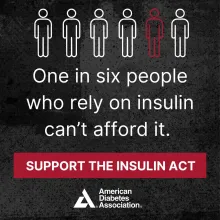
Social media infographic stating One in six people who rely on insulin can't afford it. Support the Insulin Act.

The INSULIN Act would limit out-of-pocket insulin costs for individuals with private or employer-sponsored insurance. Help bring immediate financial relief to millions of Americans—take action today: bit.ly/4a27oVk.

INSULIN Act Testimonials

“She would die due to no insulin.”—Mark

My daughter was diagnosed at 6 years old. We have had our pharmacist shed tears over the cost of our kid’s medicine to keep her alive. This is not good. What if we were not here to help her? She would die due to no insulin.

“My story is not rare and that is exactly the problem.”—Mikayla

People hear the words “insulin affordability” and think it’s political. For families like mine, it was survival.

Growing up with type 1 diabetes, my family relied on state-funded insurance because the cost of keeping me alive was already more than we could afford. One day, one of my insulin bottles shattered, and because it was before insurance would approve a refill, we were told we would have to pay hundreds of dollars out of pocket for another vial.

I remember standing in the pharmacy as my mom cried and begged them to refill it anyway. Begged them to understand that this was not optional. That without insulin, her child could die.

And I remember the look on her face when she realized she might have to choose between keeping a roof over our heads or keeping me alive.

That moment has never left me.

Insulin is not a luxury. It is not something people with type 1 diabetes can “go without until payday.” Without it, we die.

That is why insulin affordability matters. That is why legislation matters. Because no parent should ever have to plead for their child’s life at a pharmacy counter, and no child should ever have to carry the memory of watching their parent break down trying to afford their survival.

My story is not rare and that is exactly the problem.

“The girl, who has now turned into an almost 35-year-old woman with a beautiful family, is me. This is my story of my life with type 1 diabetes.”—Holle

A girl was diagnosed with type 1 diabetes at the tender age of 18 months. Diabetes became her constant companion throughout her life. She transitioned from a toddler receiving her insulin injections (where she was instructed to administer a specific amount of insulin at predetermined times throughout the day and night) via syringe and vials from her mother or a trained family member to a growing, rebellious preteen and teenager. During this phase, she was taught that failing to adhere to her insulin regimen would result in organ malfunction and a premature death, leaving her with the thought, “Jokes on you—I’m not having children or living past 32.” This rebellious attitude and hatred for the disease she had been living with led her to believe that no one could know about her diabetes. 

Consequently, there were numerous years when she only took insulin once every couple of days or weeks. Glucose meters were virtually unknown during that time. However, those rebellious years eventually culminated in the teenager, now in her 20s, being hospitalized for a week due to the most severe kidney infection caused by DKA from lack of management with insulin. This once-rebellious teenager was transforming into an adult who decided to resist succumbing to the disease she had been handed as a baby. 

She diligently attended her diabetes education classes, paid close attention to her instructors, and actively worked to lower her A1C from the 13.7 she had left the hospital with. This involved learning how to count carbohydrates, determining the appropriate insulin-to-carbohydrate ratio for meals, and mastering the mental math required for correction. The syringe and vial injections transitioned to prefilled insulin pens, along with the fingerstick glucose monitor, when she turned into an adult and made the decision to have a family. At the age of 26, she became pregnant and surprised any doctor she encountered throughout her 34-week pregnancy by maintaining her blood sugar levels within the normal range. She successfully completed the pregnancy with an A1C of 5.5. After giving birth to her daughter, she endured consistently low blood glucose readings. She had numerous ambulance rides to the hospital, where her only memory was fighting off EMTs and mumbling nonsense, mostly reciting her newborn’s birthday repeatedly. Determined to manage these fluctuations, she sought an endocrinologist’s help. Initially, she resisted the idea of an insulin pump due to concerns about the tubing and her toddler’s tendency to grab everything.

Two years later, at 28, she became pregnant with her son. She anticipated a similar experience with diabetes during this pregnancy, but it turned out to be different. Her blood glucose levels were consistently high—even higher than normal. As the pregnancy progressed, her blood glucose levels continued to rise. Eventually, she relented and switched from her prefilled insulin pens to an insulin pump, which included a tube that her toddler daughter attempted to pull and tug on.

She used the pump for a few months before reverting to her prefilled insulin pens, finally eliminating the noticeable tubing that her toddler could tug at. After the birth of her son and after consulting with three endocrinologists, she now advocates for all diabetics, highlighting the significant advancements in diabetes management.

She fondly recalls the days of syringes, vials, finger sticks, and pens, when doctors would advise taking a specific amount of insulin for each meal and checking her blood glucose levels later to adjust her insulin dosage or diet. However, she now has a tubeless insulin pump that communicates with her continuous glucose monitor. She collaborates with her endocrinologist to determine the optimal insulin-to-carbohydrate ratio. She hasn’t had an A1C over 7.6 in years. She will use her voice to let everyone, regardless of age, know that they are not alone in this fight for affordable diabetes care (which includes mental health!) for everyone, regardless of age. She wants children and teenagers to understand that if people know they have diabetes, it is okay, because chances are, everyone they will ever encounter probably knows someone with diabetes.

The girl, who has now turned into an almost 35-year-old woman with a beautiful family, is me. This is my story of my life with type 1 diabetes. My name is Holle.

“No parent should have to worry about whether they can afford the medication that keeps their child alive.”—Leah

My name is Leah, and I am the mother of my 7-year-old son, Parker, who was diagnosed with type 1 diabetes earlier this year.

His diagnosis came suddenly. Parker was hospitalized in the ICU for five days with diabetic ketoacidosis (DKA), a life-threatening complication of type 1 diabetes. Since then, our family's life has changed completely. Every day we rely on insulin, continuous glucose monitoring supplies, medical appointments, and emergency medications to keep him healthy and alive.

Affordable health insurance is not a luxury for families like ours—it is a necessity. The cost of insulin, diabetes supplies, and ongoing care can quickly become overwhelming. Without reliable and affordable coverage, many families are forced to choose between medical care and other basic needs.

My husband and I both work hard, but even with insurance, managing type 1 diabetes is expensive. Access to affordable coverage helps ensure that Parker can receive the insulin, technology, and medical care he needs to live a healthy childhood and future.

No parent should have to worry about whether they can afford the medication that keeps their child alive.

“Make sure that everybody has the proper resources that they need and to make insulin affordable for the community so that everyone can have a chance to live their life.”—Adrian

Growing up I witnessed my grandmother take insulin every day using a needle and syringe. And it was something that wasn't easy to watch, but it's something that she had to do. There have been great advancements in technology and treatment, and I encourage members of Congress to get on board with helping to make sure that everybody has the proper resources that they need and to make insulin affordable for the community so that everyone can have a chance to live their life.

“I would tell them that just because you don't see it happening in your life, doesn't mean it doesn't affect the lives of your constituents.”Elijah

Both of my grandparents have diabetes. I’ve seen them do their insulin shots and everything, seen their needles that they have to carry around, seen the thing that they have to wear on their arms to take their numbers. In college, I've also seen a lot of my friends who also have diabetes, as well as seeing them with their monitor on. And then also seeing my mother who is prediabetic pray to God she doesn't get diabetes, but seeing how that journey is taking a toll on her of with the tiredness and medication that she takes, along with her change in habits and exercise.

“However, what is she to do in the meantime?”—Belinda 

I am a nurse practitioner in the division of endocrinology at a pediatric hospital and I provide care for diabetes patients. A story that sticks with me is of a patient who is a 20-year-old female with type 1 diabetes who was diagnosed in 2012. She is living on her own, caught in the chasm of uninsured people her age. She is employed, which puts her just over the income level for Medicaid, but cannot afford her insulin, her insulin pump and continuous glucose monitor supplies, on top of her usual costs of rent and car payment. Fortunately, she will have insurance when she enters the police academy in three months. However, what is she to do in the meantime? She reports owing $5,000 for the previous supplies already. She is tearful at this appointment because she truly wants to take care of herself.

“Please do not make this highly vulnerable population pay more than we already do to manage this terrible disease.”—Lindsay

There is no one story that can begin to capture the impact that diabetes has on our population. I work with people who feel this impact every day and it deeply affects their physical, emotional, and mental wellness. In particular, I work with children as young as 13 months old that are staying alive because of insulin. 

I was diagnosed with type 1 diabetes at the age of 19 when I was a sophomore in college. I endured a five-day stay that included management on an insulin drip for the treatment of my life-threatening condition, diabetic ketoacidosis. I was in critical condition and the doctors told me I was lucky that I was not in a coma nor had I suffered more severe consequences related to my diabetes. While I had health insurance at the time and continue to do so, the cost of diabetes management remains high. In order to keep yourself safe and have the best glycemic management, it is essential to use insulin and it is highly recommended to use insulin pumps and continuous glucose monitors. The reason this matters is that people with diabetes DO NOT HAVE A CHOICE and must adhere to using insulin. Please do not make this highly vulnerable population pay more than we already do to manage this terrible disease.

“I hope one day this can be something that cannot be a concern for patients so they can properly care for their health.”—Alyssa

I am a diabetes educator who covers both inpatient and outpatient services for a healthcare system. I have seen multiple people admitted to the hospital for diabetes-related complications when unable to afford their insulin.

One story in particular sticks with me about an older gentleman diagnosed with type 2 diabetes. He was admitted to the hospital with a foot wound and an A1C over 11%. Upon chart review, many deemed him "noncompliant" as he had not taken his insulin in months. When I went in to chat with him about his diabetes, he was very open and very pleasant. He mentioned at one point he had to make a choice between his insulin or being able to make his rent, for which he chose his rent. He told me that the insulin regimen he was on (basal/bolus) was costing him close to $300 per month. I provided him with coupons to get his insulins at a discounted price, and he was more than grateful. It is a shame that something like cost is what stood in the way of him being able to properly care for his diabetes. I hope one day this can be something that cannot be a concern for patients so they can properly care for their health.

“As a clinician, it is deeply concerning to see patients who are motivated and actively engaged in managing their diabetes be hindered by insulin affordability.”—Nykkia

People who need insulin cannot afford to live without it. However, most cannot financially afford the medication. As a clinician in diabetes management, I have listened to so many stories on how patients have had to ration insulin or omit doses to be able to afford the medication. It is very disheartening to hear how someone has to choose between purchasing insulin or groceries. 

Insulin affordability is a matter of life and death, as insulin remains a critical, lifesaving medication for [some] people with diabetes. Recently, one of my patients experienced difficulty affording the insulin that has proven to work best with her insulin pump. While alternative formulary insulins are technically available, they have not provided the same level of glycemic target or consistency. As a result, she has struggled with maintaining stable blood glucose levels, creating both clinical concerns and emotional distress. 

This situation has placed her in an unfair and dangerous position. She has to make a choice between financial strain and optimal health. The out-of-pocket cost of the recommended insulin is simply not sustainable, yet without it, her diabetes management becomes significantly less effective. 

As a clinician, it is deeply concerning to see patients who are motivated and actively engaged in managing their diabetes be hindered by insulin affordability. I respectfully urge my colleagues in diabetes, advocates, and people with diabetes to strongly fight for insulin affordability!

“No parent should have to worry about whether they can afford the medication their child needs to stay alive.”—Tammi

My son was diagnosed with type 1 diabetes in 2024. Initially, his endocrinologist believed he had type 2 diabetes, but after additional testing, they called us back to let us know he actually had type 1 diabetes.

We immediately began diabetes education and started by closely monitoring his blood sugar levels. At first, monitoring alone was enough to help manage his condition. Eventually, however, his blood sugar became more difficult to control, and he was prescribed insulin.

The cost of insulin was a huge shock to me, and I was incredibly grateful to have health insurance at the time. Unfortunately, there came a period when I was unemployed and no longer had insurance, which meant the cost of insulin came directly out of my pocket. I was fortunate to qualify for a patient assistance program that covered his insulin for six months, but I often think about what would have happened if that program had not been available. No parent should have to worry about whether they can afford the medication their child needs to stay alive.

Today, my son is doing well. Like many teenagers, he sometimes gets frustrated with having to check his blood sugar and take insulin when his friends don't have to think about those things. Even so, he has remained committed to managing his diabetes, and I am incredibly proud of him. We have not experienced any diabetes-related emergencies or hospitalizations, and for that, I am truly grateful.

Our family's journey has shown me both the emotional and financial challenges that come with living with type 1 diabetes. It has also taught us resilience, the importance of education, and the value of having access to affordable healthcare and lifesaving medications.

“Patients should not have to choose between insulin to live and being able to afford their bills.”—Brandie

As a diabetes educator, the cost of insulin is a major barrier for my patients. When treating both type 1 diabetes and type 2 diabetes patients, having access to affordable insulin is essential for them. When insulin costs are elevated, patients with type 1 diabetes are choosing between staying alive or paying bills. For those patients living with Medicare who are already limited by income barriers, the cost capping in effect has made it possible for many of them to receive therapy that they need. Patients should not have to choose between insulin to live and being able to afford their bills.

“One missed dose can be critical.”—Angie

I am a mother of two children living with type 1 diabetes. Both of my children's lives depend on having insulin every second of their life. One missed dose can be critical. As a mother, there nothing more important to me than knowing I did everything I possibly could do in life to make sure that when they grew up they would be able to afford their insulin so they could live a comfortable life without worrying about the cost of their medication. Having type 1 diabetes requires so much energy, time, and money. As a mother, I have had to miss many days of work and had countless sleepless nights caring for my children as they grow up. It is my life mission to raise awareness for insulin affordability one conversation at a time. We will continue to sign every petition for the INSULIN act until insulin is affordable for everyone.